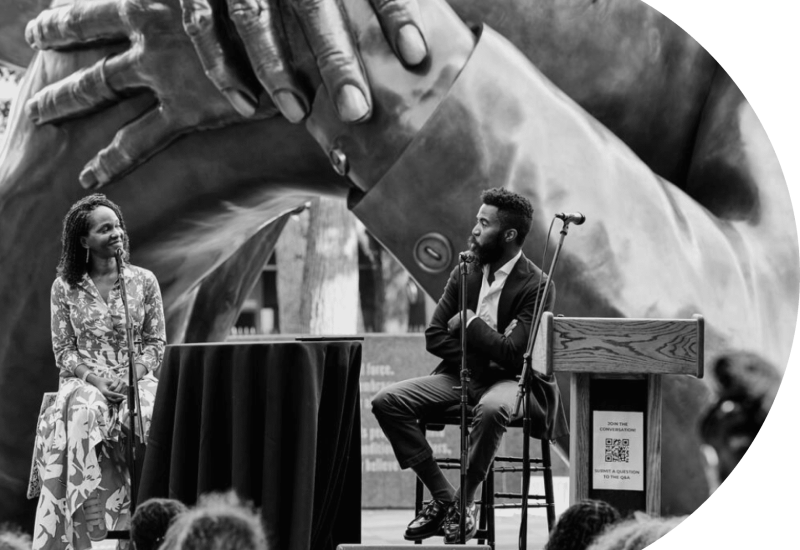
The first component of the program is a month-long retreat held at MIT in the month of July: this serves as a space for writers and film and television industry professionals to collaborate. Adaptation Lab Fellows will each submit applications in advance of coming to Cambridge to work on film and television projects—each adapted from a classical or contemporary work of literature—that they want to see live another life on-screen. This cohort, while in residence here in Massachusetts, will offer one another creative support on their projects in a weekly workshop setting. Each participant is also paired with a mentor, and will have the chance to be in direct conversation with visiting speakers throughout the summer.
In this way, the retreat provides a space of professionalization for writers interested in a range of career paths—actor, screenwriter, director, or some combination of these—while also showcasing MIT’s strengths as a research institution, and hub for creative practice across disciplines. At the end of our retreat, we facilitate a pitch for each of the Adaptation Lab fellows with one of our partnering studios.
The second major component of our work in the Lab is an arts education program. For our pilot program in Massachusetts in 2022, we met bi-weekly with a cohort of high school students on the South Shore, as well as their faculty advisors, to explore several community archives in Boston and Cambridge: The Schlesinger Library at Harvard’s Radcliffe Institute, MIT Distinctive Collections, and the Boston Athenaeum. By the close of the spring semester, the students produced a suite of original artworks inspired by this archival study undertaken over the course of the academic year. These deliverables served as material examples of our overarching claim: that there are dynamic, practicable ways to combine historical research with arts education as a means of preparing young people for college-level work in the arts, engineering, and beyond.